
The Twilight Zone
A study into the confusing dimension where everybody take threes, but they never go in
The System
There’s no team in college basketball that plays quite like the University of South Alabama. In fact, there might not be one in the world. The Jaguars are running a scam on defense, a smoke-and-mirrors zone that tricks opponents into taking nothing but contested threes all game. On average, a college basketball team will take 40% of their shots from behind the three point arc. Central Arkansas is in the 99th percentile of the share of their opponents’ shots that come from behind the three point arc, conceding (or forcing, I suppose) 54.4% three point attempts. Central Arkansas is as close to the next 60 teams in defensive three point rate as they are to South Alabama, the #1 three point rate defense, whose opponents take a staggering 64.4% of their shots from three, and make just 31.5% of them. That’s a three pointer on nearly two-thirds of all possessions, being knocked down at a rate worse than 83% of teams’ season average. It’s madness.
I’ve seen the South Alabama zone myself, and it’s such a frustrating thing to watch that I can only imagine how enraging it must be to face. In my first rec league basketball game last week, our opponents went zone from the first possession of the game, and the ensuing chaos was a dire indictment of how well my team of little basketball experience will fare this season, but also a poignant reminder of just how daunting these unusual defenses can prove. My middle school basketball coach spent hours of practice time on a 2-3 zone shell that we implemented for maybe three possessions all season, so I’ve also seen the flip side of how exhausting the process of learning and understanding such a counterintuitive way to play can be for beginners.
As much as I loathe the endless possessions of passing around the perimeter (South Alabama ranks top ten in longest opponent possessions, per KenPom), I can’t help but be fascinated by such an unorthodox and extreme style. You see, South Alabama isn’t an elite defensive team; for all of the plaudits I can give them, their defensive efficiency has never risen above 80th nationally, per KenPom, during the tenure of mad scientist head coach Richie Riley. I wanted to dive into what sorts of teams perform better or worse against South Alabama, depending on their own tendencies when it comes to the three point shot. Does South Alabama take advantage of terrible three point shooting teams, or do they goad good three point shooting into poor attempts? Hopefully, the secrets to their universe can prove enlightening, or at the very least give me an edge on the market.
The Test
I broke up South Alabama’s schedule so far based on three variables:
1. Did South Alabama cover the spread?
2. Do their opponents make a high percentage of their threes?
3. Do their opponents take three point shots at a high rate?
The first variable is important, as I want to figure out when South Alabama overperforms expectations or their season averages and when they underperform those marks, rather than simply when they win or lose. By using gambling spreads as a benchmark, I can control for opponent quality and hopefully provide a useful application for the findings.
The second and third variables are two measures that indicate whether the opponents should be able to “punish” the flaw in the defense, that being the concession of three pointers. In theory, we’d expect teams with strong three point percentages who are used to taking a lot of threes to fare the best against this style of defense, while teams with poor three point percentages unaccustomed to high volume would fare worst.
The Conspiracy
As I split their season opponents into buckets based on shooting, I couldn’t help but notice that so many of their opponents were bad three point shooting teams. In fact, of the nine non-conference opponents that South Alabama faced, just one ranked in the top third of the nation in three point percentage, and that was South Alabama’s opponent in the MAC-Sun Belt Challenge, a predetermined matchup over which they had no control. I’ve begun to suspect that Richie Riley intentionally sought to schedule games against poor three point shooting teams who would particularly struggle with the Jaguars’ defense.
I was even more surprised to find the trend of poor opponent three point percentage continue into South Alabama’s Sun Belt slate. I began to wonder: had Richie Riley not only crafted his non-conference schedule to match his defense, but had he crafted his defense to match his conference schedule? Three point chicanery has only been a feature of South Alabama’s defense for the past two seasons – in fact, just the season before, the Jaguars only gave up 28.7% of shot attempts as threes, fifth lowest in the entire nation. The Sun Belt, as a league, has collectively posted one of the worst three point percentages of any conference for five seasons running, plenty of time for Riley to notice the trend and decide that his team would exploit this particular weakness of their regular opponents.
The Results
Overall, South Alabama is 10-10 against the spread this season, although that may vary slightly depending on where you look. They’ve gone 6-3 as underdogs, but just 4-7 as favorites, which should negate any possibility that overperformance against bad shooting teams is just, well, overperformance against bad teams in general. I categorized each game they’ve played based on the three variables, with shooting simply split into above average or below average, to give eight possible permutations for each game. For example, in their opener, South Alabama covered the spread against Toledo, who has an above average three point percentage but a below average three point attempt rate. Here is South Alabama’s record covering the spread against each type of team this season:
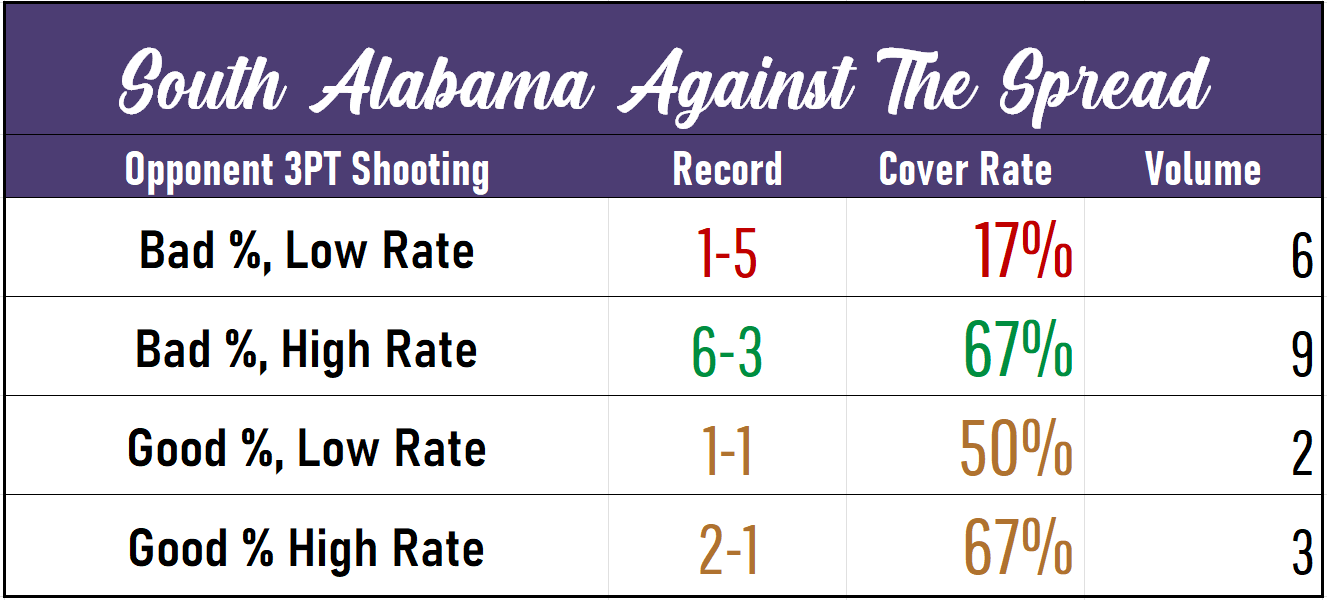
As you can see, the scheduling has been such that we don’t have a great idea of how the zone plays against good shooting teams, but that alone may be an indicator that it wouldn’t fare well. What’s more striking is the reversal between South Alabama’s cover rate against poor three point percentage teams that don’t shoot threes, and those that insist on doing so anyway. It might seem obvious that teams who are not proficient at three pointers and yet take many of them wouldn’t be strong opponents and thus would be easy to cover against, but remember that we’re measuring with gambling spreads here, which already bake in the relative team ability based on algorithms like KenPom. It’s rather shocking that a defense predicated on allowing as many threes as possible would abnormally struggle against teams that can’t shoot threes, but, perhaps, that’s because other opponents are already employing similar strategies against these teams, so South Alabama’s scheme doesn’t stand out.
However, in the five games that the Jaguars failed to cover against bad %, low 3P rate teams, opponents “took the bait”, so to speak, attempting a ludicrous 37 three point attempts per game: that’s more than any team in the country takes on a nightly basis. If anything, South Alabama’s unique defense might allow these teams to create the three point looks that don’t naturally generate from the flow of their offense. South Alabama’s success against bad %, high 3P rate teams seems to stem from encouraging these teams to do what they do poorly, while preventing the ways they normally make up for it. In South Alabama’s cover against UTSA, they goaded the Roadrunners, Division I’s third-worst three point percentage team, into taking 56 three pointers and fouled them just once.
The Case Study
As I write this, South Alabama is warming up for their Sun Belt game at Appalachian State in Boone. South Alabama are 5.5 point underdogs, and the Mountaineers are a below average three point shooting team that takes three pointers at an above average rate. All signs point toward a comfortable Jaguars cover, especially as the gambling public have nudged the line a full point in the opposite direction.
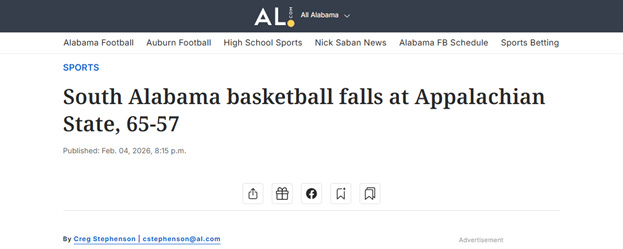
Well, this is awkward.
I’m not going to feel too bad; it was a one point game with 2:20 to play, and South Alabama forced Appalachian State into 39 three pointers that the Mountaineers only knocked down at a 28% clip. The Jaguars’ own offense was so woeful (37% from the field) that it didn’t even matter. That’s just variance for you, there’s still a 40% gap in cover likelihood between the two types of poor shooting teams, but it sure doesn’t feel great after I double leveraged South Alabama on my spreadsheet simulation of the college basketball betting market based on this research and have now lost a significant amount of imaginary money. And that’s exactly why I only spend my imaginary money on this stuff.
The Outlook
Assuming that the App State game isn’t a harbinger of trend reversal, South Alabama should look forward to their matchup with Arkansas State on February 14th. The Red Wolves, likely favorites in this matchup, rank 302nd in three point percentage, but 80th in attempt rate, the exact formula for the cover that South Alabama should’ve closed out against Appalachian State. Unfortunately, South Alabama will have to face underdogs Southern Miss before then, a terrible three point shooting team that knows exactly who they are; that won’t be the last South Alabama sees of their Gulf neighbors either, as they’ll end the season with another matchup. If I can’t pick up any wins betting on this defense, I better hope I can make some fake coin betting against it.
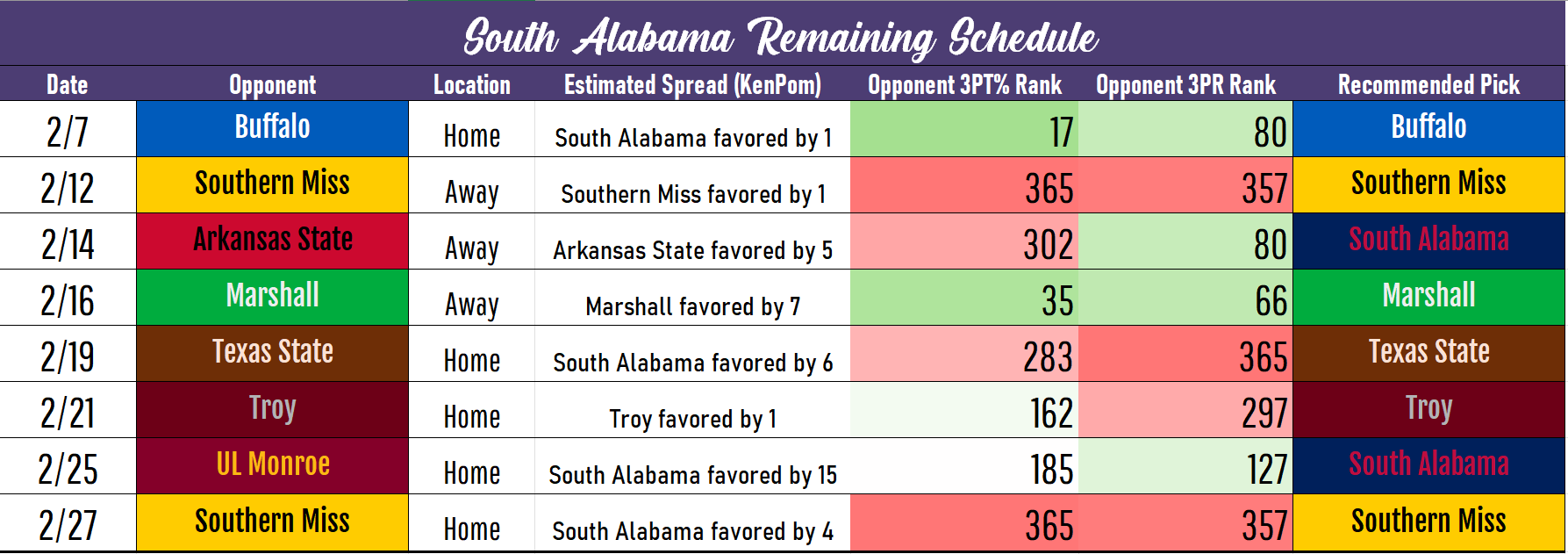
It seems that South Alabama’s zone isn’t just confusing to play against, but confusing to analyze as well. Despite the defense achieving its goal of forcing teams to take bad threes all game, South Alabama fares worse than expected against teams that aren’t used to taking many threes than they do against teams that love taking bad threes. In the process, though, I think I’ve unraveled something far more interesting: teams with outlier styles in college basketball are likely crafting their systems to exploit weaknesses across the conference and then hunting down non-conference opponents that share those flaws. If you hear a knock from Richie Riley, don’t answer it. You won’t like the world that you step into when you open that door.

Fascinating deep dive on how Riley engineered both schedule and scheme around conference weaknesses. The reversal where they struggle against bad-shooting teams that dont take threes is counterintuitive but makes sense if those teams already face similar pressure elsewhere. I coached HS ball and we ran zone purely for matchups, the exhaustion of teaching it to beginers for marginal return was always the tradeoff.